bookmark_borderNatural Air Purifiers, Aromatic Plants, and Phytoncides

By Daniel Brouse

Air pollution is: a leading cause of death worldwide, the leading cause of climate change, and the greatest threat to humankind. There is not much an individual can do about the outdoor air quality; however, there is a lot one can do to improve their individual air quality. The EPA reports, risks from long-term exposure to indoor pollution “include some respiratory diseases, heart disease and cancer, can be severely debilitating or fatal. It is prudent to try to improve the indoor air quality in your home even if symptoms are not noticeable.” In the Spring of 2023, wildfires in Canada made the symptoms noticeable to many residents in the United States. Outdoor air quality measured hazardous for days in a row. When people could see and smell the air quality, it became obvious. Their indoor air quality also became noticeably poor.

With extreme weather events increasingly impacting both outdoor and indoor air quality, a long-term breathing experiment is underway.

No matter where your virgin air comes from, most likely the best way to purify the air is with plants.

The most famous study was conducted by NASA to remove formaldehyde from the air and found spider plants removed 95 percent of the toxic substance from a sealed Plexiglas chamber in 24 hours.

As part of the long-term breathing experiment we have cultivated multiple generations of spider plants. They are a great place for a novice to get started. Spider plants thrive in bright to moderate light. In the spring and summer, once-a-week watering is sufficient. During the winter, the soil should dry between waterings. (Spider plants are almost as easy to care for as cacti.) Snake plants are also easy to grow in all kinds of lighting situations, require little watering, and are one of the best air purifying plants.

Aromatic Plants and Phytoncides
Almost all plants are good for air purification. The spider plant and snake plants are great for taking pollutants out of the air, as well as optimize sustainability. The long-term breathing experiment is also looking at adding to the air quality.

Aromatherapy and Forest Bathing are easy to implement in your natural air purification experiment. Many plants can help take contaminants out of the air while adding medicinal properties to the air. Rosemary, mints, basil, sage, and most other herbs can add anti-bacterial, anti-depressant, anti-anxiety, stress, pain relief and other beneficial properties to air quality.

During the Air Quality Crisis of 2023, the long-term breathing experiment collided with the Tree Extinction Experiment. As part of the tree experiment, we grow a small nursery of trees in containers. Their main purpose is usually outside to act as a windblock for the structure to help reduce heating and cooling energy needs. Luckily, during the hazardous air quality days we were able to bring some (spruce and oak) inside to help purify the air and add phytoncides. The US Department of Agriculture reports, “These chemicals are natural oils that plants use to defend themselves against unwanted pests such as insects, bacteria or fungi. Phytoncides improve the human immune system by increasing natural killer cell activity. These cells respond rapidly to virus-infected cells and tumor formation. Studies show that increased natural cell activity can last for more than 30 days after a trip to a forest, suggesting that a trip once a month would enable individuals to maintain a higher level of natural killer cell activity. Other benefits from phytoncides include an increase in anti-cancer proteins; a reduction in blood pressure, heart rate and stress hormones; reduced test scores for anxiety, depression, anger, fatigue, and confusion; and increased scores for vigor.”

Trees known to produce especially high levels of phytoncides include the evergreen trees (Cedars, Spruces, Conifers and Pine) and Oak trees.

Read the full article.

More on Clean Water, Air, Healthy Plants and Good Nutrition

More Things You Can Do to Help the Environment and Your Health

Natural Indoor Plant Air Purifiers

bookmark_borderAir Pollution Cause of Cognitive Decline and Dementia

In a UK study, a causal relationship has been established between air pollution and cognitive decline / dementia. The primary cause is a decline in blood flow to the brain.

Cognitive decline, dementia and air pollution

COMEAP reviewed nearly 70 studies in human populations (epidemiological studies) which looked at possible links between air pollution and a decline in mental ability and dementia in older people. They also considered studies which investigated how air pollution might affect the brain.

From this review, it can be concluded that it is likely that air pollution does contribute to these effects. The most likely way this occurs is through effects on the circulation. It is known that air pollutants, particularly small particles, can affect the heart and blood vessels, including to the brain.

WORST CITIES FOR OZONE POLLUTION
#1: Los Angeles-Long Beach, CA
#2: Bakersfield, CA
#3: Visalia, CA
#4: Fresno-Madera-Hanford, CA
#5: Phoenix-Mesa, AZ
#6: San Diego-Chula Vista-Carlsbad, CA
#7: Denver-Aurora, CO
#8: Houston-The Woodlands, TX
#9: Sacramento-Roseville, CA
#10: Salt Lake City-Provo-Orem, UT
#11: Las Vegas-Henderson, NV
#12: El Paso-Las Cruces, TX-NM
#13: San Jose-San Francisco-Oakland, CA
#14: New York-Newark, NY-NJ-CT-PA
#15: El Centro, CA
#16: Chicago-Naperville, IL-IN-WI
#16: Dallas-Fort Worth, TX-OK
#18: Fort Collins, CO
#19: San Luis Obispo-Paso Robles, CA
#20: Chico, CA
#21: Reno-Carson City-Fernley, NV
#22: Albuquerque-Santa Fe-Las Vegas, NM
#23: Redding-Red Bluff, CA
#24: Detroit-Warren-Ann Arbor, MI
#25: San Antonio-New Braunfels-Pearsall, TX

WORST CITIES FOR PARTICLE POLLUTION
#1: Bakersfield, CA
#2: Fresno-Madera-Hanford, CA
#2: Visalia, CA
#4: San Jose-San Francisco-Oakland, CA
#5: Los Angeles-Long Beach, CA
#6: Medford-Grants Pass, OR
#7: Fairbanks, AK
#8: Phoenix-Mesa, AZ
#9: Chico, CA
#10: El Centro, CA
#11: Sacramento-Roseville, CA
#12: Cincinnati-Wilmington-Maysville, OH-KY-IN
#13: Indianapolis-Carmel-Muncie, IN
#14: Pittsburgh-New Castle-Weirton, PA-OH-WV
#15: Bend-Prineville, OR
#16: Detroit-Warren-Ann Arbor, MI
#16: Redding-Red Bluff, CA
#18: McAllen-Edinburg, TX
#18: Philadelphia-Reading-Camden, PA-NJ-DE-MD
#18: Eugene-Springfield, OR
#21: Yakima, WA
#22: Chicago-Naperville, IL-IN-WI
#22: Houston-The Woodlands, TX
#24: St. Louis-St. Charles-Farmington, MO-IL
#25: Augusta-Richmond County, GA-SC
#25: Shreveport-Bossier City-Minden, LA

Air Pollution and Health

bookmark_borderClimate Change And Wellness

The AGU Science Policy Conference released this statement on global warming:

When climate change affects what we eat, the air we breathe, and the water we drink, the consequences can be deadly. Changes in climate also affect weather conditions, causing illnesses related to heat and incidents connected to severe weather events. The EPA even says that the spread of climate-sensitive diseases, such as a new strain of West Nile virus that emerged in 2002, depends partly on climate factors. In response, government and health officials must monitor climate change and implement policies for adapting to change while also mitigating risk.

bookmark_borderDangers to Children: Sun, Bugs and Breathing

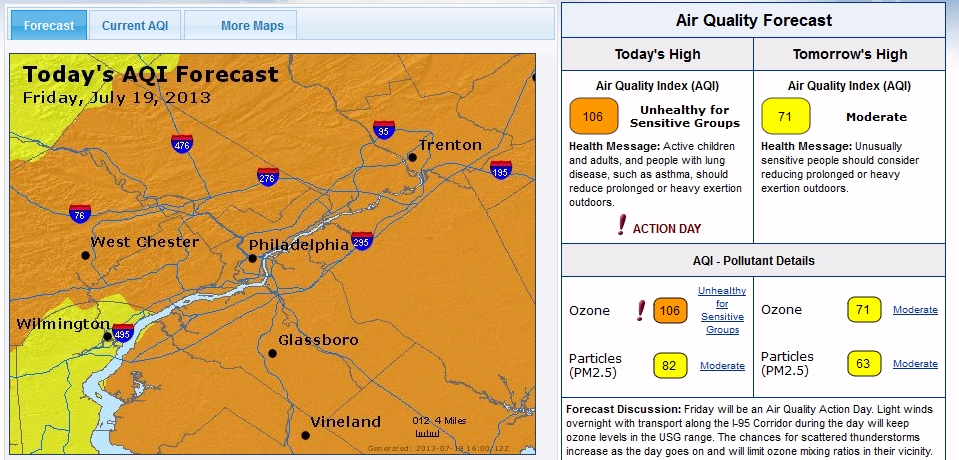
Dangerous Air Quality Due to Ozone Levels

What are three of the most dangerous natural threats to children? Exposure to the sun, mosquitoes (West Nile Virus), ticks (Lime Disease) and breathing. However, reducing your risk to these can create health risks as well. Too much sunscreen may prevent the body from producing vitamin D. The chemicals in insect repellent can pose a slew of long term health risks.

Obviously, not breathing results in death.  For instance, the day this article was in Philadelphia the government issued an “Action Day” where they advise active children not to breath outside.

Learn More About the Dangers of the Sun, Mosquitoes and Breathing
Philadelphia’s Air Quality


bookmark_borderHealth And Climate Change

Learn more about global warming.

by MedlinePlus Trusted Health — Information for You A service of the U.S. National Library of Medicine from the National Institutes of HealthNational Institutes of Health

Weather can be hot or cold, dry or wet, calm or stormy, clear or cloudy. Climate is the average weather in a place over a long period of time. Changes in climate may be due to natural forces or from human activities. Today climate changes are happening at an increasingly rapid rate.

Climate change is altering weather and climate patterns that previously have been relatively stable. Climate experts think that climate change will bring increasingly frequent and severe heat waves and extreme weather events, as well as a rise in sea levels. These changes have the potential to affect human health in direct and indirect ways.

* Climate change affects the social and environmental determinants of health – clean air, safe drinking water, sufficient food and secure shelter.
* Global warming that has occurred since the 1970s caused over 140 000 excess deaths annually by the year 2004.
* The direct damage costs to health (i.e. excluding costs in health-determining sectors such as agriculture and water and sanitation), is estimated to be between US$ 2-4 billion/year by 2030.
* Many of the major killers such as diarrhoeal diseases, malnutrition, malaria and dengue are highly climate-sensitive and are expected to worsen as the climate changes.
* Areas with weak health infrastructure – mostly in developing countries – will be the least able to cope without assistance to prepare and respond.
* Reducing emissions of greenhouse gases through better transport, food and energy-use choices can result in improved health.